For CTOs
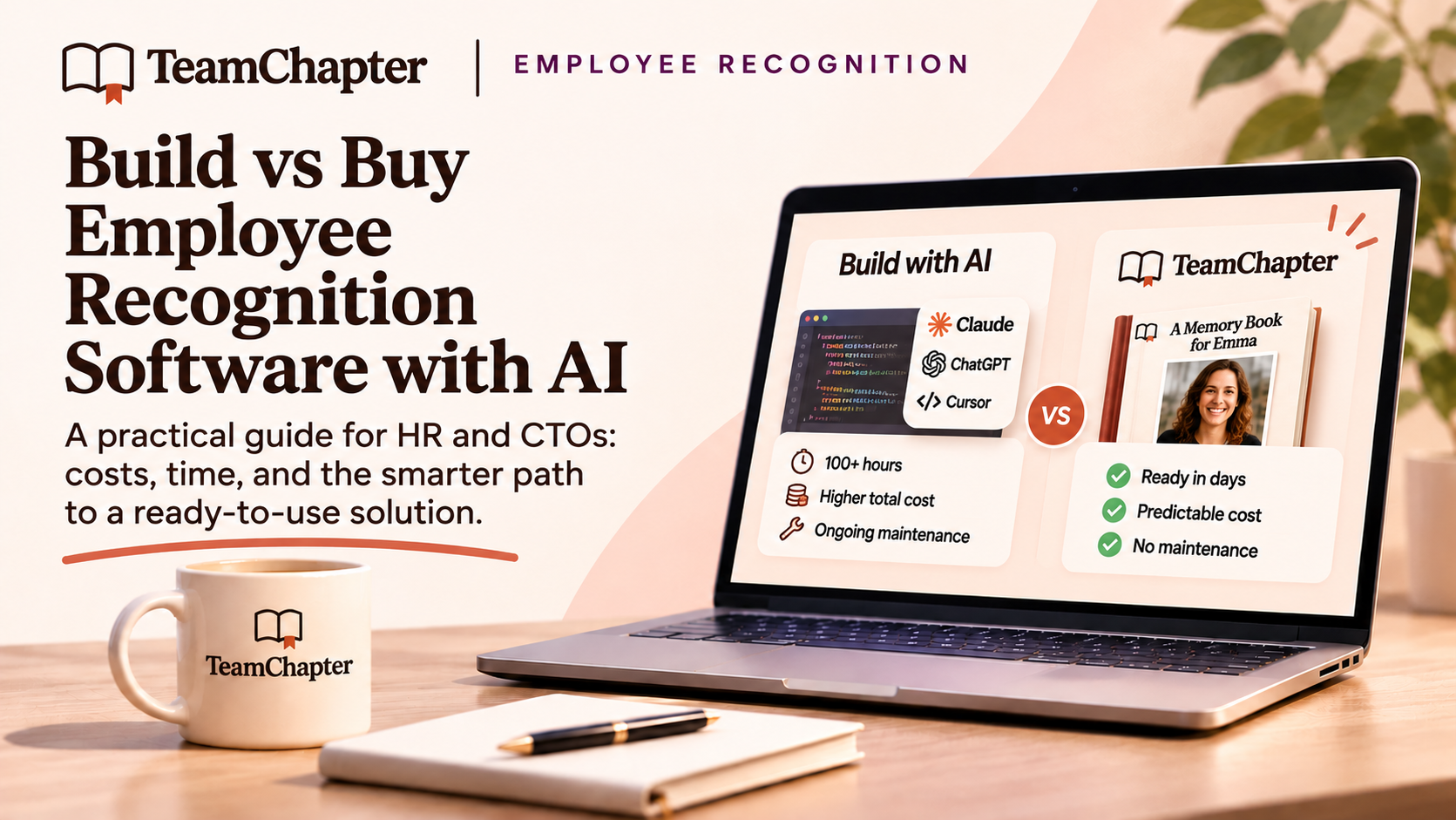
Build vs Buy Employee Recognition Software with AI Coding Tools
Should your team build an employee recognition app with Claude Code or Cursor, buy SaaS, or customize source code? A practical CTO decision framework.
By TeamChapter · · 8 min read
The short answer
AI coding tools can accelerate implementation, but they do not remove product decisions, integration work, security review or maintenance. Compare hosted SaaS, a new internal build and an existing source-code starting point against your actual requirements.
The request that looks like a weekend project
HR wants better birthday and anniversary recognition. The initial request sounds small: send a reminder, let colleagues leave messages, and show the result to the employee.
Then the questions arrive. Where do employee records come from? Who is allowed to organize a book? Can contributors participate without accounts? How are photos stored? Who can see them? What happens when someone leaves? Which reminders go to Slack or email? How does the team handle deletion requests?
A coding agent can help write code for each answer. It cannot decide which answer your company should choose.
Three practical approaches
| Approach | Best fit | What you still own |
|---|---|---|
| Hosted recognition SaaS | Fast rollout with vendor-supported workflows | Vendor review, configuration, data governance, recurring fees |
| Build from scratch with AI tools | Unusual requirements and available engineering capacity | Architecture, product decisions, QA, security, integrations, maintenance |
| Customize an existing codebase | Requirements broadly match an existing app and you want code control | Code review, changes, deployment, third-party services, maintenance |
What Claude Code, Cursor and similar tools change
Repository-aware coding agents make it easier to explore a codebase, propose modifications and generate tests. They are especially useful when a developer can evaluate the output and iterate quickly.
They do not make authentication, permissions, data retention, email deliverability or HRIS integrations disappear. Generated code still needs to be tested against real workflows, production secrets and the company's security requirements.
The most useful question is not whether AI can generate an anniversary app. It can generate a starting point. The useful question is how much of the full application you want your team to design, validate and own.
The scope hidden behind a Memory Book
You may not need every capability on day one. A pilot with one team can reveal which requirements matter before a company-wide rollout.
- Milestone rules and employee data, including date changes and leavers.
- Organizer access, contributor links and recipient permissions.
- Writing, photos, uploads, moderation and delivery.
- Email and workplace notification setup.
- Storage permissions, retention, backups and incident response.
- Accessibility, mobile use, monitoring and support.
How to evaluate existing source code
- Inspect the repository and its commercial license before planning redistribution or modifications.
- Run the application in a development environment and test a complete organizer-to-recipient flow.
- Review the data model, authorization checks, storage and external service dependencies.
- Map required HRIS, Slack and Teams behavior against what is implemented and what still needs verification.
- Estimate engineering time for changes, testing, deployment, documentation and future upgrades.
- Agree internally who will operate and maintain the application after launch.
Where TeamChapter fits
TeamChapter offers a free hosted Memory Book for trying the experience and a separate $99 one-time source-code license for teams that want to customize and deploy the application themselves.
The source-code option can be a useful starting point if your requirements resemble the existing recognition workflows. It is not a managed enterprise implementation. Your team is responsible for reviewing the code, configuring infrastructure and third-party services, validating integrations, and handling maintenance.
If you want zero operational responsibility, a supported hosted SaaS may be the better choice. If you need extensive custom behavior, compare the cost of adapting the existing code with building a new application.
A decision framework for the CTO and HR lead
The license fee is rarely the largest cost in a custom internal tool. The larger question is what your engineering team will need to build, verify and maintain.
- Ask HR to demonstrate one real milestone, not a list of abstract features.
- Identify which workflows are essential, optional or out of scope.
- Compare a hosted service, an AI-assisted new build and an existing codebase using the same requirements.
- Include ongoing operations and security review in every estimate.
- Choose the smallest pilot that can reveal a real limitation.
Explore the next step
Evaluating an internal deployment? Review the source-code license, responsibilities and technical scope.