Buying guides
Digital Group Cards for Work Anniversaries: What to Compare
Comparing digital group cards for employee anniversaries? Look at contribution flow, photos, delivery, keepsakes, privacy and ownership before choosing.
By TeamChapter · · 7 min read
The short answer
A good digital group card makes it easy for colleagues to contribute and for the recipient to enjoy the result. Compare the actual recipient experience, not just templates or the number of signatures allowed.
First decide what you want the recipient to receive
Some teams want a colorful card signed by twenty people. Others want a collection of stories and photos that feels closer to a small book. Both are reasonable choices, but they create different experiences.
If the aim is a quick group greeting, look for a low-friction card with a clear deadline and easy delivery. If the aim is to capture memories, look for a format that makes room for longer writing, personal photos and a recipient experience worth returning to.
The comparison checklist
| Criterion | What to test | Why it matters |
|---|---|---|
| Contributor access | Can people write without creating accounts? | Fewer steps for occasional contributors |
| Prompts | Does the product help people write something specific? | More than twenty variations of congratulations |
| Photos | Can colleagues add photos easily on mobile? | Memories are often visual |
| Delivery | What exactly does the recipient open? | The result matters more than the editor |
| Privacy | Who can access the book and its media? | Personal stories deserve clear controls |
| Branding | Can you adapt the design or messaging? | Useful for a repeatable HR program |
| Ownership | Hosted service, export, or editable source code? | Changes who controls customization and maintenance |
| Price | Per card, subscription or one-time license? | Different economics for occasional versus frequent use |
Group cards are not all the same
Established group-card services may support photos, videos, scheduled delivery, gifts and printable keepsakes. Don't assume they only offer plain text or that their messages vanish. Check the current product and plan for the features you need.
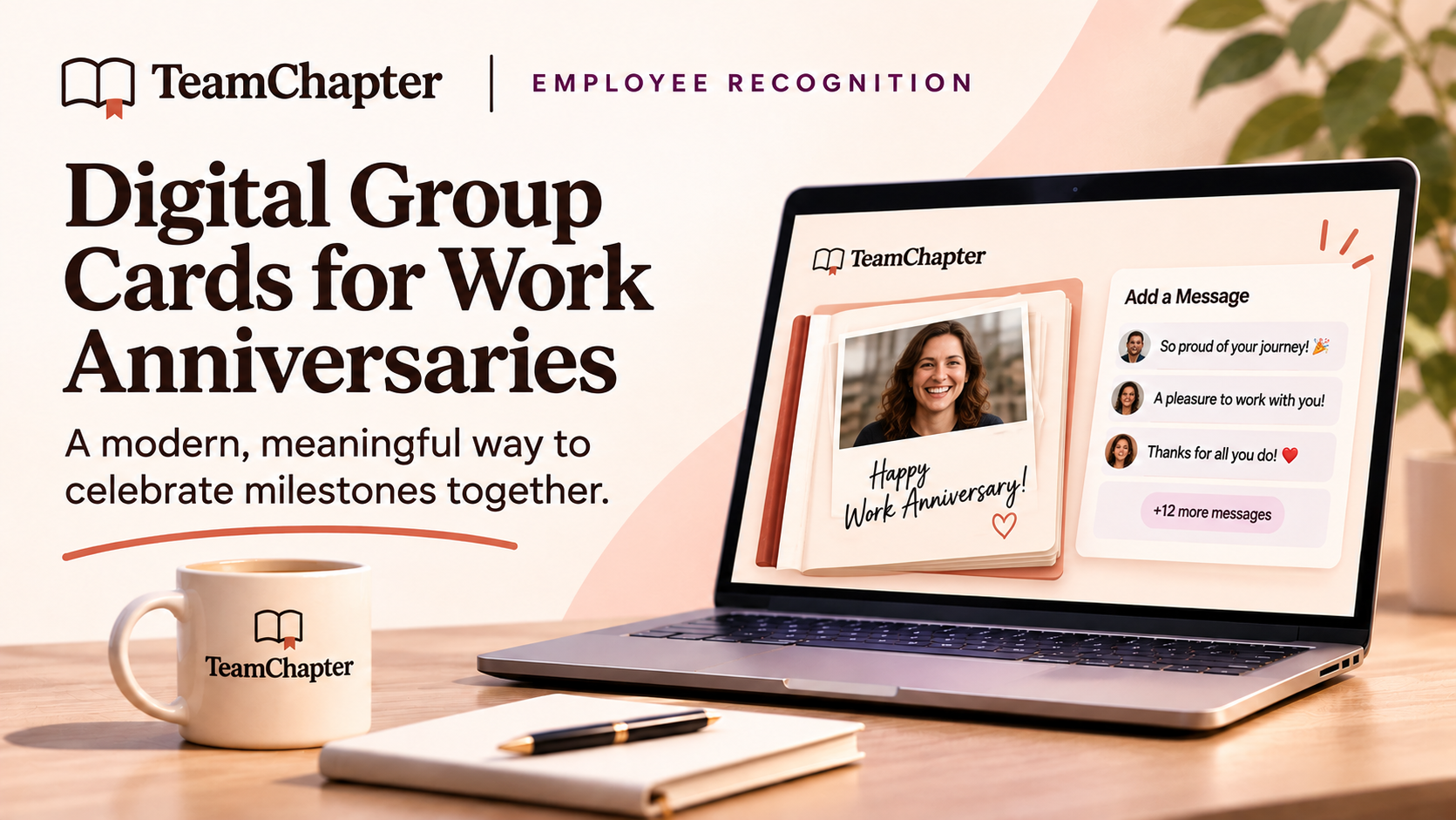
TeamChapter approaches the occasion as a Memory Book: one link for colleagues to add messages and photos, with guided writing to help people find something specific to say. Its free version is useful for testing a single milestone. Its separate $99 source-code license is intended for teams that want to inspect and customize an application.
A fair way to compare options
Do not judge solely by a polished template gallery. The real test is whether a busy colleague can contribute something personal and whether the recipient likes the final experience.
- Create the same sample anniversary in two or three products.
- Invite three people: one who writes easily, one who needs a prompt, and one who contributes from a phone.
- Ask them to add a message and a photo, then note where they hesitate.
- Open the delivered result as the recipient, not as the organizer.
- Check access, storage, editing, export, price and the vendor's current terms.
When a traditional digital group card wins
- You want a familiar signed-card format and minimal setup.
- You need a specific gift, print or video feature available from a card provider.
- You already have a vendor with the right privacy and purchasing approvals.
- You don't need to modify the software or manage employee milestone workflows.
When a Memory Book makes more sense
- The occasion deserves several stories or photos, not just signatures.
- You want writing prompts to make contributions more personal.
- You want to repeat the process for work anniversaries and other employee milestones.
- Your IT team may eventually want to adapt and operate the source code.
Before committing to a company rollout
Run one free pilot. Record how many people contributed, how long organizing took, and what the recipient said. Then compare the true cost of repeating the process, including HR time.
For companies considering TeamChapter source code, the $99 price covers the license, not hosting, integrations, implementation or ongoing maintenance. That is a different purchasing decision from a hosted group-card subscription.
Explore the next step
Planning employee milestones? Explore the HR workflow or create a free Memory Book to test it with your team.